


For decades, foreign entrepreneurs viewed Japan through a welcoming lens, drawn by stable markets, world-class infrastructure, and a relatively low barrier to entry for commercial business creation. However, regulatory thresholds have shifted dramatically. The Japanese immigration landscape for foreign founders has decisively pivoted away from low-cost nominal entities toward substantial, verifiable economic contribution.
For global executives, founders, and corporate investors planning market entry, understanding these updated rules is critical to protecting capital, executing compliant company registration in Japan, and ensuring long-term operational continuity. If you are modeling your startup budget or evaluating whether you need an immediate incorporated presence, exploring our Japan company setup cost breakdown and running scenarios through our business cost calculator will help ground your expansion roadmap.
What changed on 16 October 2025
The legal framework governing foreign corporate executives and company owners underwent a structural overhaul introduced by the Immigration Services Agency of Japan (ISA). For years, the minimum baseline required to establish a commercial presence and secure status of residence (Zairyu Shikaku) was modest—requiring only ¥5 million in capital or two full-time employees—a standard often criticized for enabling nominal shell companies.
Authorities responded by tightening the criteria to filter out paper vehicles and attract serious commercial players. The modernized rules govern every new foreign applicant entering the country, as well as existing visa holders seeking status changes or periodic extensions.
The regulatory focus has shifted from mere formal registration to demonstrating tangible operational substance, financial solvency, and deep local market integration.
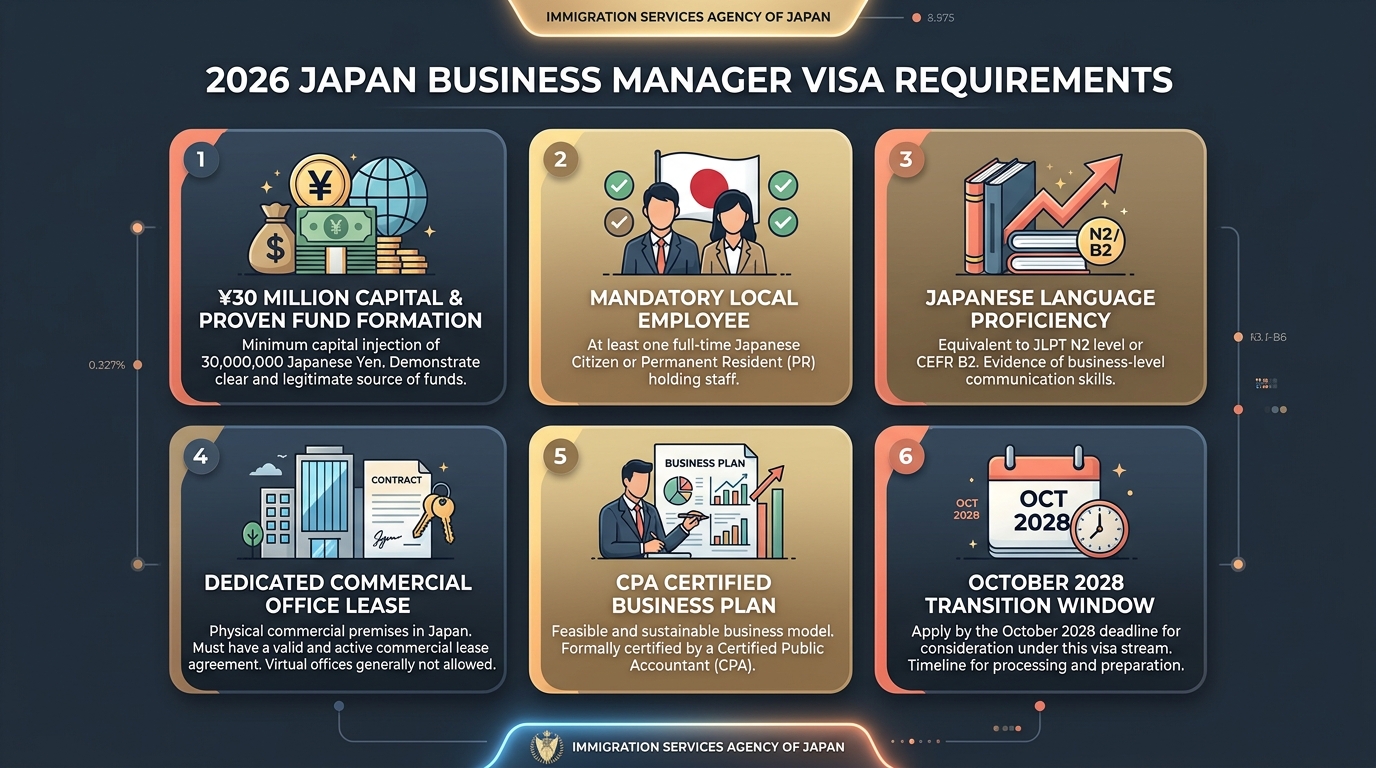
Capital requirement: ¥30 million
The most striking change is the six-fold increase in the minimum capital threshold:
- Previous Rule: Minimum capital investment of ¥5,000,000 (~$33,000 USD).
- Current Rule: Minimum capital investment of ¥30,000,000 (~$200,000 USD).
This capital must be genuine, unencumbered funds that flow directly into the corporate entity to finance active commercial operations, whether structured as a Kabushiki Kaisha (KK) or a Godo Kaisha (GK).
Verifiable Source of Funds (Fund Formation Trail)
Beyond merely displaying the required balance in a corporate bank account, immigration authorities now demand an exhaustive, verifiable audit trail demonstrating the legitimate origin of funds. Founders must document how capital was accumulated over time:
- Cumulative personal salary savings corroborated by multi-year personal income tax certificates (Gensen Choshuhyo or foreign tax returns).
- Documented corporate dividend distributions or proceeds from equity divestments.
- Verified proceeds from certified real estate or asset sales.
| Parameter | Pre-October 2025 Standard | 2026 Modernized Visa Framework |
|---|---|---|
| Minimum Paid-in Capital | ¥5,000,000 (~$33k USD) | ¥30,000,000 (~$200k USD) |
| Local Staff Requirement | 0 (if capital met) or 2 local staff | At least 1 mandatory full-time local staff |
| Language Benchmark | None mandated | JLPT N2 / CEFR B2 / BJT 400+ (Founder or Staff) |
| Business Plan Evaluation | Basic narrative plan | Certified Professional Audit (CPA, Tax Accountant, or SME Consultant) |
| Premises Verification | Virtual/shared offices occasionally allowed | Independent commercial lease with dedicated private office |
Staff, language and experience requirements
Establishing a presence in Japan no longer permits a solitary founder to operate entirely in isolation. Statutory compliance now requires satisfying specific human capital and professional capability benchmarks:
1. Mandatory Local Hiring
Companies must hire at least one full-time employee who holds:
- Japanese citizenship,
- Permanent Resident (PR) status,
- Spouse or Child of Japanese National status, or
- Permanent Resident Spouse / Long-Term Resident status.
Operating as a solo, one-person entity without domestic staff is no longer legally viable under the Business Manager category. The sponsoring entity must enroll the employee in statutory labor insurance (Rousai Hoken) and employment insurance (Koyou Hoken) through proper payroll and social insurance mechanisms.
2. Functional Language Proficiency
To ensure genuine integration into Japanese commerce, the regulatory framework requires demonstrated Japanese language proficiency:
- Benchmark: CEFR B2 level, Japanese-Language Proficiency Test (JLPT) N2, or a Business Japanese Proficiency Test (BJT) score of 400 and above.
- Application Rule: This requirement can be fulfilled by either the foreign applicant or the full-time local staff member. If the founder does not speak fluent Japanese, hiring a bilingual local manager or specialist who holds N2 certification satisfies the statutory threshold.
3. Management Background & Professional Track Record
Immigration officers evaluate the applicant's administrative competence through verified credentials:
- A master's degree or higher in business administration (MBA), finance, economics, or a commercially relevant field; OR
- A minimum of three years of documented professional management or business administration experience (which may include graduate-level business study).
Office and business plan requirements
Physical substance has definitively replaced virtual office addresses and co-working hot-desk arrangements. Immigration inspectors conduct on-site physical audits and require photographic proof that premises correspond to the registered business scope.
Independent Commercial Premises
- Strict Commercial Lease: Using a residential apartment as a dual-purpose living and office space is strictly prohibited for new applications.
- Physical Demarcation: The facility must feature an independent entrance, dedicated lockable doors, company signage, and permanent equipment suitable for the entity's commercial activities.
Professional Business Plan Verification
Submitting an informal, self-drafted financial projection is no longer sufficient. Under the updated framework:
- Business plans must carry a formal evaluation report or validation stamp from a licensed Japanese professional, such as a Certified Public Accountant (CPA), a certified tax accountant (Zeirishi), or a registered Small and Medium Enterprise Management Consultant (Chusho Kigyo Shindanshi).
- These accredited experts evaluate the business model's commercial feasibility, three-year financial sustainability, cash flow projections, and compliance with statutory corporate tax filing standards.
Transition rules for existing visa holders
Founders already residing and operating in Japan under the legacy ¥5 million framework are not required to increase their paid-in capital overnight. A structured transition framework protects bona fide ongoing investments:
- Grace Period Through October 2028: Existing Business Manager visa holders have a transitional grace period lasting until October 2028 to progressively adapt their capital reserves, employment structure, and operational compliance.
- Renewal Scrutiny: During periodic extension reviews within this grace window, immigration authorities closely examine commercial traction, corporate revenue trends, clean annual audit and tax filings, and mandatory enrollment in employee health and pension schemes (Shakai Hoken).
Alternatives: Startup Visa and intra-company transfer
For international entrepreneurs who find the ¥30 million upfront capital commitment prohibitive during the initial proof-of-concept phase, strategic alternative visa categories remain available:
1. Local Government Startup Visa Programs
Special Economic Zones across Japan—including Tokyo, Fukuoka, Osaka, Kobe, and Sendai—administer regional Startup Visa Programs. These initiatives grant an initial 6-month to 1-year residency period, enabling founders to live in Japan, draft business plans, establish banking relations, and raise required capital before transitioning into the full national Business Manager status.
2. Intra-Company Transferee Visas
Established multinational corporations expanding existing overseas operations into Japan can transfer senior directors, branch managers, or technical specialists via the Intra-Company Transferee work visa. This route bypasses the direct ¥30 million personal capital test, leveraging the foreign parent company's financial balance sheet.
3. Interim Testing via Employer of Record (EOR)
If you need to deploy local commercial representatives or business development managers immediately without establishing an incorporated subsidiary or committing capital upfront, utilizing a compliant Japan Employer of Record (EOR) enables immediate operational hiring while corporate structuring is finalized.
Frequently Asked Questions
The minimum baseline capital requirement stands at ¥30 million (JPY 30,000,000) for new applicants, up from the historical ¥5 million threshold. This capital must be fully paid-in, deposited into an active corporate bank account, and substantiated with a verifiable audit trail proving legitimate fund formation.
Preparing Your Market Entry for 2026 and Beyond
Japan remains one of the world's most stable, lucrative, and technologically advanced commercial markets. However, the era of casual market testing through nominal paper companies has definitively concluded. The regulatory shifts signal a clear directive from Japanese authorities: international enterprises must demonstrate long-term commitment, legitimate financial resources, and domestic economic contribution from day one.
For global founders and corporate leadership, succeeding under these rigorous standards depends on disciplined advance preparation. Aligning your capital documentation, corporate structure, commercial leasing, and staffing strategy early transforms regulatory hurdles into a distinct competitive advantage.
To review your market entry strategy, evaluate corporate entity structures, or coordinate your immigration roadmap, contact our Japan advisory team to schedule a confidential consultation.


