


When foreign business leaders expand into Asia, Hong Kong is usually at the top of the list. The city offers low tax rates, simple trade rules, and a fast, streamlined incorporation process. But right after completing your company registration in Hong Kong, local statutory compliance rules come into play.
One core statutory pillar is appointing a company secretary.
Many business owners treat this requirement as a trivial checkbox task, assuming the secretary is merely someone who files an administrative form once a year. That is a costly misconception. In Hong Kong, your company secretary serves as your corporate guardian. They protect your business from statutory penalties, maintain clean corporate governance, and ensure your enterprise remains in good standing with regulatory authorities.
If you are planning your market entry, evaluating your Hong Kong company setup cost, or reviewing how to register a company in Hong Kong as a non-resident, here is a practical guide to Hong Kong company secretary requirements, qualification criteria, statutory duties, and compliance enforcement.
1. The Legal Requirement for a Company Secretary
Under Section 474 of the Hong Kong Companies Ordinance (Cap. 622), every private limited company incorporated in Hong Kong must appoint a company secretary. This is a strict statutory requirement rather than an optional corporate formality.
The law mandates this role to guarantee an accountable local anchor for corporate governance. Corporate governance represents the legal safeguard framework ensuring an enterprise operates transparently and honors statutory obligations. Regulatory agencies—including the Companies Registry and the Inland Revenue Department (IRD)—require a dedicated, verified local liaison who maintains accurate corporate registers, receives statutory summons, and produces company documentation upon official inspection.
2. Who Qualifies: Residents and TCSP License Holders
The Companies Ordinance enforces rigorous eligibility criteria. You cannot appoint an arbitrary acquaintance or an overseas colleague to serve as your corporate secretary in Hong Kong.
Depending on whether you appoint a natural person or a corporate entity, the statutory rules specify:
Appointing an Individual Secretary
- Must be a natural person who ordinarily resides in Hong Kong.
- Must hold a valid Hong Kong Permanent Identity Card or an appropriate residence/work visa.
- Cannot be the sole director of the company (see Section 4 below).
Appointing a Corporate Secretarial Firm
- Must maintain its registered office or principal place of business physically located in Hong Kong.
- Must hold a valid Trust or Company Service Provider (TCSP) license issued by the Companies Registry under the Anti-Money Laundering and Counter-Terrorist Financing Ordinance (Cap. 615).
| Qualification Criterion | Individual Secretary | Licensed Corporate Provider (TCSP) |
|---|---|---|
| Residency Requirement | Must ordinarily reside in Hong Kong | Physical registered office in Hong Kong |
| Regulatory Licensing | Not required for private staff | Mandatory TCSP License from Companies Registry |
| AML/CTF Obligations | Bound by general Companies Ordinance | Formally vetted under strict Anti-Money Laundering rules |
| Suitability for Foreign Founders | Suitable only if employing local resident executive | Ideal for non-resident directors and offshore holding groups |
A TCSP license certifies that the service provider has undergone thorough background investigations by regulatory authorities, satisfied "fit and proper" compliance standards, and implemented formal anti-money laundering protocols. Always verify a secretarial provider's active TCSP license number before engaging their services.
3. Duties: Registers, Filings, and Minutes
A company secretary manages legal, statutory, and administrative compliance throughout the corporate lifecycle. Their core operational duties center around four essential areas:
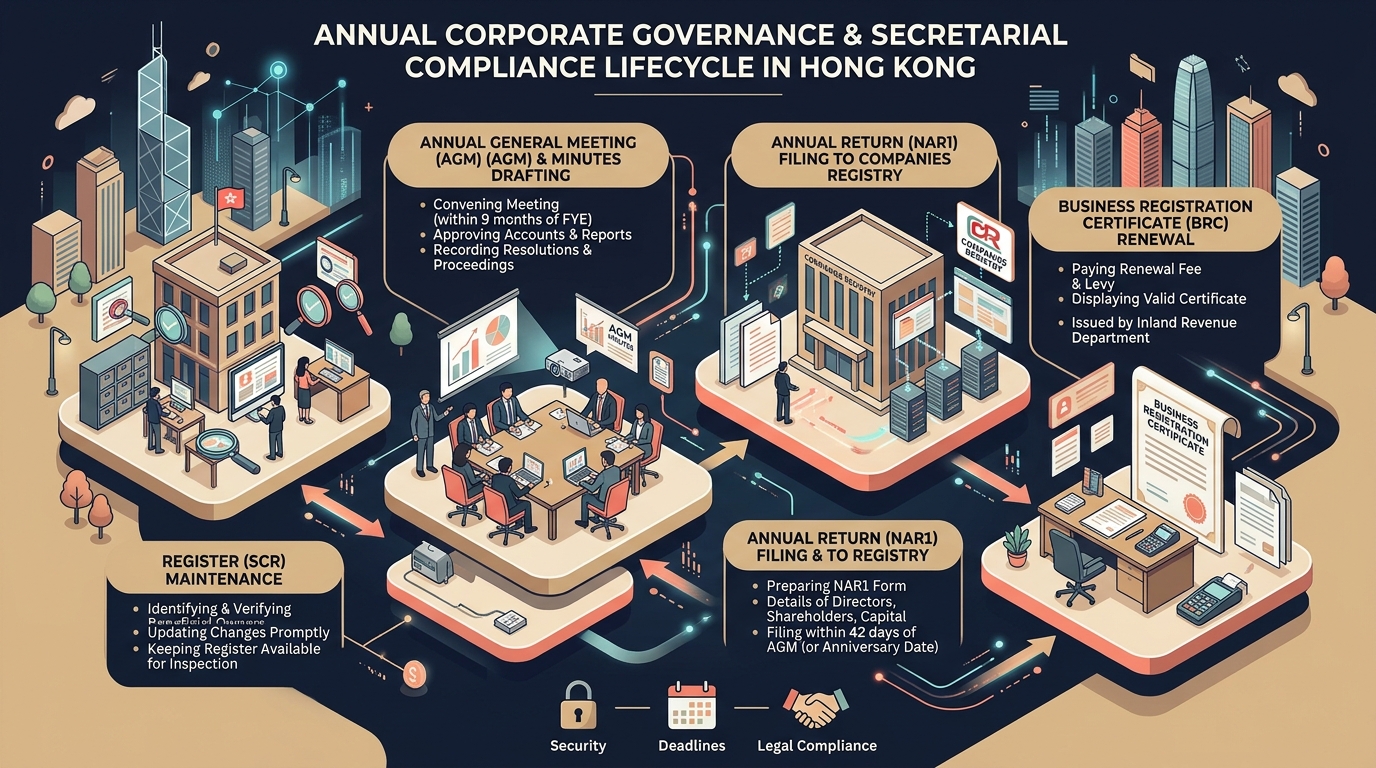
Keeping Statutory Registers
Your secretary is legally responsible for preparing and updating your statutory books, which must be kept at your registered office or designated inspection address:
- Register of Directors and Company Secretaries
- Register of Members (Shareholders)
- Significant Controllers Register (SCR): Mandatory record identifying ultimate beneficial owners holding more than 25% voting rights or ownership, accessible to law enforcement officers upon demand.
- Register of Charges and Mortgages
Submitting the Annual Return (Form NAR1)
Every private company must submit an Annual Return (Form NAR1) to the Companies Registry once every year. The return documents your verified registered office address, current share capital structure, and up-to-date particulars of directors and shareholders. The statutory deadline is strictly within 42 days after the anniversary of the company's date of incorporation.
Convening Meetings and Drafting Board Minutes
When the board of directors adopts strategic resolutions—such as approving annual statutory audit accounts, opening bank accounts, declaring dividends, or altering capital—your secretary drafts compliant board minutes and shareholder resolutions. These records establish that the company followed lawful governance procedures.
Managing Regulatory Changes & Corporate Filings
Throughout the operating year, any corporate changes must be filed within statutory time limits:
- Director or Secretary Appointment/Resignation (Form ND2A/ND2B): Within 15 days.
- Change of Registered Office Address (Form NR1): Within 15 days.
- Allotment or Transfer of Shares (Form NSC1): Within 1 month.
4. Can a Director Also Be the Secretary?
A frequent question from international founders is whether they can hold both the director and company secretary roles simultaneously. The legal rule under the Companies Ordinance depends on your board structure:
- Two or More Directors: Yes. If your company has two or more directors, one director is legally permitted to serve concurrently as company secretary—provided that individual ordinarily resides in Hong Kong.
- Sole Director: No. Under Section 475(2) of the Companies Ordinance, a sole director cannot serve as the company secretary. Furthermore, a sole director who is also a director of a corporate secretarial entity cannot appoint that entity as company secretary.
The law prohibits a sole director from doubling as secretary to establish an essential system of internal checks and balances, preventing unchecked unilateral actions.
Even when multiple directors permit an internal appointment, most founders choose to outsource company secretarial services. Managing international client sales, supply chains, and tax advisory strategies leaves little bandwidth to track evolving Registry guidelines, Gazette notifications, and statutory deadlines.
5. Cost of Outsourced Company Secretarial Services
Outsourcing secretarial obligations to a licensed TCSP provider is the standard best practice for international enterprises, remote founders, and expanding teams. It eliminates the overhead of hiring a full-time local compliance officer while providing institutional compliance backing.
Most professional corporate services firms offer annual retainer packages:
| Service Tier | Typical Annual Pricing | Key Inclusions |
|---|---|---|
| Essential Secretarial Retainer | HKD 2,500 – 4,500 (~$320 – $580 USD) | Named licensed company secretary, Annual Return (NAR1) preparation, statutory register maintenance, official correspondence receipt |
| Comprehensive Compliance Package | HKD 5,000 – 9,000 (~$640 – $1,150 USD) | Includes Essential tier plus Designated Representative for Significant Controllers Register (SCR), AGM coordination, and standard director/address updates |
| Corporate Group & Holding Tier | HKD 10,000+ (~$1,280+ USD) | Multi-entity governance, complex share allotment drafting, dividend resolutions, cross-border restructuring support |
When evaluating providers, review whether routine corporate resolutions and annual government filing disbursements (such as the HKD 105 Companies Registry fee) are bundled into the retainer or billed separately. Partnering with a firm that provides transparent, flat-fee pricing prevents unexpected administrative add-ons. You can evaluate comprehensive entity operational costs through our Hong Kong business cost calculator.
6. Penalties for Non-Compliance
The Companies Registry and Inland Revenue Department enforce corporate compliance through systematic automated tracking. Overlooking statutory obligations triggers progressive escalation:
1. Late Annual Return (NAR1) Escalation Fees
The standard registration fee for filing on time within 42 days is HKD 105. If the deadline lapses, the registration fee increases dramatically based on delay:
| Filing Delay Period | Companies Registry Statutory Fee |
|---|---|
| Filed within 42 days of anniversary | HKD 105 |
| Between 42 days and 3 months late | HKD 870 |
| Between 3 months and 6 months late | HKD 1,740 |
| Between 6 months and 9 months late | HKD 2,610 |
| Exceeding 9 months late | HKD 3,480 |
2. Court Summons & Director Liability
Persistent failure to file an Annual Return or failure to maintain the Significant Controllers Register constitutes a criminal offence. The court issues formal summons directly to the company and its individual directors, imposing personal fines up to HKD 50,000 plus daily continuing fines of HKD 1,000 for each day the default continues.
3. Banking Restrictions & Company Striking-Off
Financial institutions in Hong Kong conduct periodic "Know Your Customer" (KYC) audits against Companies Registry records. If an enterprise shows late filings, missing registers, or an expired Business Registration Certificate, banks will freeze transaction capabilities. In severe cases, the Registrar initiates formal striking-off, vesting company assets in the Hong Kong Government as bona vacantia.
Frequently Asked Questions
Yes. Under Section 474 of the Hong Kong Companies Ordinance (Cap. 622), every private limited company registered in Hong Kong must appoint a company secretary. Operating without a named secretary or leaving the position vacant exposes the company and its directors to criminal prosecution and financial fines.
Conclusion & Next Steps
A company secretary in Hong Kong is not merely an administrative formality; they are your first line of defense in maintaining a legally sound, compliant enterprise. As cross-border financial transparency and regulatory scrutiny intensify, working with a qualified, licensed TCSP secretarial partner insulates your directors from personal liability, ensures error-free filings, and frees your leadership team to focus on commercial expansion.
Establishing and administering a business in a foreign jurisdiction requires precision and reliability. Whether you are incorporating a new enterprise, transferring your secretarial records, or aligning your corporate governance with statutory standards, our licensed advisory specialists are here to support your operations with complete transparency.
Contact our advisory team today to discuss your Hong Kong secretarial requirements or schedule an introductory compliance consultation.


