


For foreign investors planning to enter the Chinese market, registered capital has long been a major planning item. Under past rules, setting up a Wholly Foreign-Owned Enterprise (WFOE) meant dealing with strict timelines for cash injections. However, the regulatory landscape has shifted. The implementation of the China Company Law 2024 has introduced critical structural changes, most notably the mandatory five-year contribution limit.
Understanding how registered capital in China works under these modern rules is essential for protecting your corporate cash flow, maintaining corporate compliance requirements, and avoiding costly missteps during incorporation. If you are comparing corporate models across the region or testing your market runway, running preliminary numbers through our China business cost calculator and assessing structural trade-offs in our Company Setup Wizard will help you budget your commitments with precision.
What registered capital is and why it matters
Registered capital is the total amount of equity that shareholders legally commit to contribute to a company. It is not an administrative registration fee paid to the government. Instead, it acts as the initial financial cushion and working capital base of the business.
In China, this figure is written directly into your company's articles of association and is permanently recorded on your official business license. Local authorities—led by the State Administration for Market Regulation (SAMR)—look at your registered capital to determine if your enterprise has adequate liquidity to sustain daily operations, pay local staff, honor commercial contracts, and cover limited liabilities.
| Dimension | Low Capital Declaration | Optimal Capital Declaration | Excessive Capital Declaration |
|---|---|---|---|
| Cash Flow Risk | High (immediate cash crunch) | Balanced (covers 12–18 months runway) | Low operational risk, high treasury lock-in |
| Shareholder Liability | Low initial cash commitment | Aligned with realistic operational plan | Legally enforceable 5-year cash injection debt |
| Foreign Debt Quota | Severely restricted borrowing limit | Proportionate cross-border loan capacity | Large borrowing capacity, unnecessary exposure |
| Regulatory Scrutiny | High risk of SAMR/Bank pushback | Fast approval & smooth bank onboarding | Heightened capital verification & tax audits |
The 2024 Company Law five-year contribution rule
The most consequential change in the updated Company Law involves the registered capital contribution deadline.
In the past, China operated on a relaxed subscription system (renjiao zhi). Investors could state a massive registered capital figure—such as USD 5 million or RMB 50 million—and choose an arbitrary contribution timeline extending twenty, thirty, or even fifty years into the future.
The new law closes this loophole by introducing a strict five-year cap. Under Article 47 of the revised law, all shareholders of a limited liability company must fully pay their subscribed paid-in capital in China within five years from the company's official date of incorporation.
Transition Window for Existing Enterprises
Companies registered before July 1, 2024, that previously set contribution deadlines beyond five years are not grandfathered indefinitely. State Council regulations establish a three-year transition period (running until June 30, 2027) during which pre-existing entities must adjust their articles of association to bring their remaining contribution schedules into compliance with the five-year ceiling.
| Parameter | Pre-2024 Subscription Regime | 2024 Company Law Framework |
|---|---|---|
| Contribution Deadline | Up to 20–30+ years, self-determined | Strict maximum of 5 years from incorporation |
| Paid-in Verification | Infrequent, self-reporting on annual return | Enhanced public disclosure on National Enterprise Credit System |
| Shareholder Acceleration | Limited creditor acceleration rights | Creditors can accelerate unpaid capital upon insolvency |
| Pre-existing Entities | Flexible adjustment timelines | Mandatory 3-year transition window (July 2024 – June 2027) |
This statutory shift brings greater financial discipline and credibility to the Chinese commercial market. While it preserves the flexibility growing businesses need to inject funds incrementally, it eliminates the practice of declaring speculative, unfunded registered capital sums.
How much capital to declare for a WFOE minimum capital
Many international founders ask about the official WFOE minimum capital requirement. Under Chinese national law, rigid statutory minimum capital requirements were eliminated for general business categories over a decade ago.
However, "no legal minimum" does not mean foreign investors can incorporate an enterprise with nominal sums like RMB 1 or USD 1,000. In practice, SAMR licensing officials and commercial banks evaluate whether your declared registered capital aligns with the scale, scope, and geography of your commercial model.
For example, a consulting or software firm in Shanghai or Shenzhen may only need a modest capital injection to cover office rent and employee payroll for its initial gestation period. Conversely, a manufacturing WFOE or a commercial trading enterprise dealing with physical inventory and customs clearances will require a substantially higher capital commitment to pass operational feasibility reviews.
When determining your entity's optimal registered capital, consider three core practical factors:
- Facility Rent & Lease Commitments: Projected rent for your physical office or facility for at least 12 to 18 months, including commercial lease deposits.
- Local Payroll & Social Insurance: Projected payroll costs, including mandatory municipal pension, medical, housing fund, and payroll contributions for all local and foreign staff.
- Specialized Licensing Hurdles: Specific business scopes—such as telecommunications, financial services, medical device distribution, or bonded logistics—retain statutory minimum capital thresholds mandated by line ministries.
| Sector Classification | Practical Registered Capital Range | Primary Expense Drivers |
|---|---|---|
| Consulting & Professional Services | RMB 200,000 – RMB 600,000 (~$30k – $85k) | Office lease, executive salaries, tax disk setup |
| Technology, Software & SaaS | RMB 500,000 – RMB 1,500,000 (~$70k – $210k) | R&D payroll, cloud infrastructure, IP filing |
| Import/Export & Commercial Trading (FICE) | RMB 1,000,000 – RMB 2,000,000 (~$140k – $280k) | Inventory procurement, customs bond, warehousing |
| Industrial Assembly & Manufacturing | RMB 3,000,000 – RMB 5,000,000+ (~$420k – $700k+) | Plant lease, equipment, environmental assessments |
Injecting capital and FX registration
Once you decide on your registered capital amount, transferring the funds into the country requires strict adherence to Chinese banking controls and foreign exchange regulations. This cross-border process is known as capital injection in China.
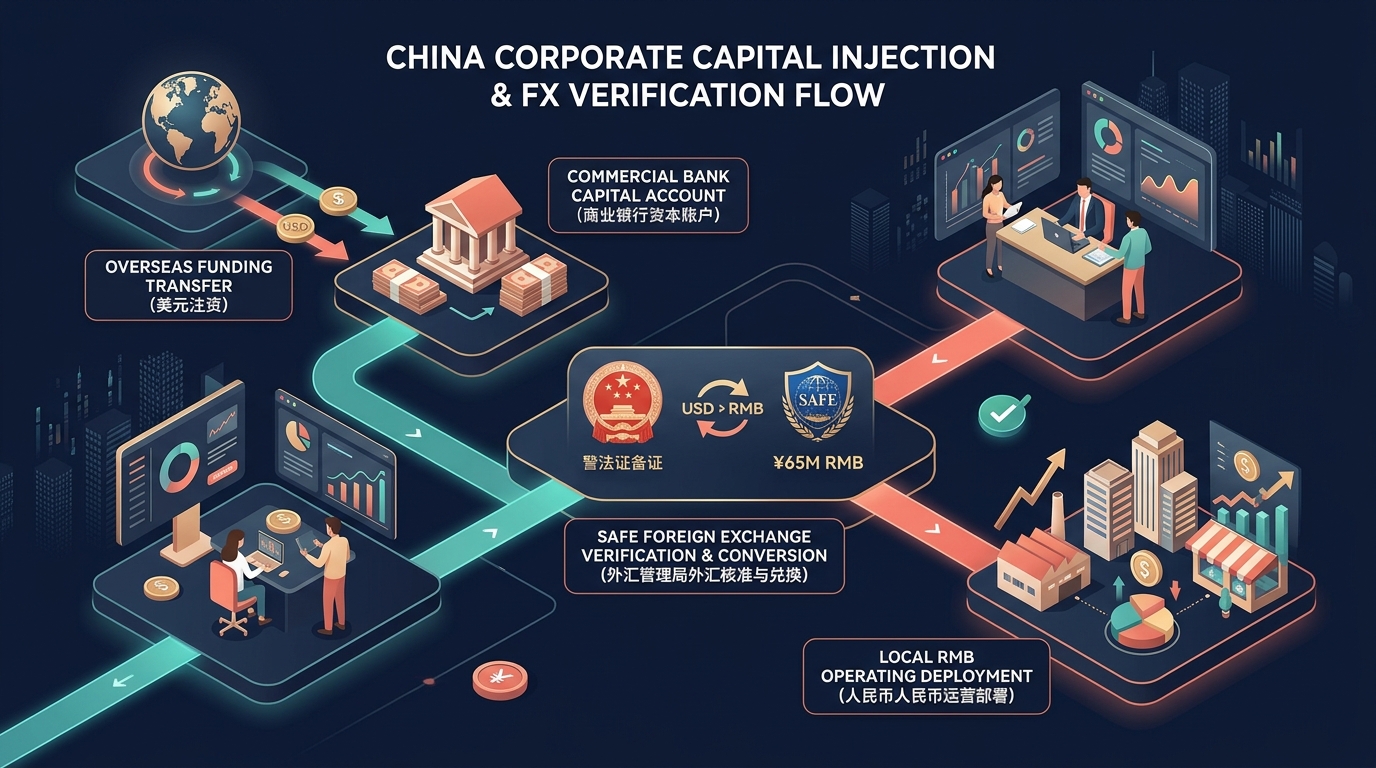
Foreign currency cannot simply be wired into a standard domestic operating account. The capital contribution follows a structured foreign exchange (FX) procedure:
- Foreign Exchange Registration: Following SAMR business license issuance, your enterprise must complete foreign exchange registration with the State Administration of Foreign Exchange (SAFE) via an authorized commercial bank.
- Dedicated Capital Account Opening: The company opens a dedicated foreign currency capital account (Zibenjin Zhanghu) at an approved commercial bank in China.
- Cross-Border Wire Transfer: The overseas parent company wires funds directly from its offshore corporate account into the newly established China capital account. The remittance slip must explicitly specify "Capital Contribution" or "Registered Capital Injection" in the transfer remarks.
- SAFE Verification & FX Settlement: Upon arrival, the receiving bank and SAFE verify the wire's origin, foreign investor identity, and purpose against your registered articles of association.
- Conversion to RMB Settlement Account: Under China's Willingness Foreign Exchange Settlement system, the foreign currency can be converted into Renminbi (RMB) and transferred into the enterprise's basic RMB operating account for commercial utilization.
Maintaining clean transaction records, bank confirmation slips, and formal capital verification receipts (Ziyang Baogao) during this phase is essential for annual statutory audit and assurance compliance and future profit repatriation.
Reducing or increasing registered capital
Business plans evolve, and enterprise leaders may find that their initial registered capital declaration requires an upward or downward adjustment.
Increasing Registered Capital
If your business expands faster than projected and requires additional liquidity or a higher foreign debt ceiling, increasing registered capital is relatively straightforward. The shareholders adopt a formal capital increase resolution, amend the articles of association, submit the amendment to SAMR, update the foreign exchange quota with the bank, and execute the subsequent capital remittance.
Reducing Registered Capital
Reducing registered capital, however, is a significantly more complex and heavily scrutinized legal undertaking.
Because registered capital represents a public guarantee fund to safeguard creditors, lowering that number reduces the company's formal liability shield. Under Chinese corporate law:
- The enterprise must adopt a shareholder resolution approving the capital reduction and prepare a comprehensive balance sheet and inventory of assets.
- The company must formally notify existing creditors within 10 days of the resolution.
- A public announcement of capital reduction must be published on the National Enterprise Credit Information Publicity System for a mandatory 45-day notice period.
- Creditors hold the statutory right to demand full debt repayment or adequate loan guarantees before the capital reduction can proceed.
If creditors raise objections or outstanding liabilities remain unresolved, SAMR will reject the application. Consequently, setting an accurate, realistic registered capital figure from day one saves extensive legal expense and administrative delays. If your enterprise is navigating structural amendments, reviewing corporate restructuring strategies ensures compliance at every stage.
Risks of under- or over-capitalizing
Choosing the wrong registered capital number introduces distinct operational and financial vulnerabilities:
Under-capitalization risks
- Cash Flow Shortages: If your initial capital allocation fails to sustain operations until client revenues arrive, your local entity will face liquidity shortfalls.
- Foreign Debt Borrowing Quota Caps: Foreign-invested enterprises in China cannot borrow unrestricted sums from overseas parent entities. Under both the traditional "gap between total investment and registered capital" ratio and the macro-prudential cross-border financing framework administered by the People's Bank of China (PBOC), your maximum foreign debt quota is directly pegged to your registered capital size. If registered capital is too low, your parent company is legally prohibited from extending shareholder loans to bail out the subsidiary.
- Commercial Licensing Delays: Local licensing bureaus may withhold operational permits if declared capital appears inadequate for the scope of activities.
Over-capitalization risks
- Unfulfilled 5-Year Legal Liability: Under the 2024 Company Law, shareholders are personally or corporately liable to pay the full subscribed capital within five years. If an entity commits to an inflated amount (e.g., USD 5,000,000) but only injects USD 500,000, the parent company remains on the hook for the remaining USD 4,500,000.
- Creditor Claims & Acceleration: If the company faces litigation, insolvency, or debt default, creditors can petition the court to accelerate the unpaid registered capital, compelling foreign shareholders to inject the outstanding balance immediately.
- Capital Trapping: Bringing excess capital into China that is not deployed productively can trap treasury funds, as repatriating unutilized capital requires a cumbersome capital reduction or formal liquidation and deregistration process.
Moving Forward with Confidence
Navigating corporate setup and capital requirements in China demands rigorous financial planning and a nuanced understanding of current statutory frameworks. Getting your corporate structure right from inception shields your balance sheet, preserves foreign exchange agility, and builds a sustainable foundation for long-term commercial growth.
Whether you are launching a new WFOE, evaluating capital contribution schedules for existing subsidiaries, or aligning your corporate governance with the new Company Law, our cross-border advisory team is here to assist.
To evaluate your expansion plans, model your required working capital, or structure your entity efficiently, contact our advisory team today to schedule a confidential strategy session.
Frequently Asked Questions
For most standard business categories, national law does not enforce a strict financial minimum. However, specific industries, such as banking, insurance, telecommunications, and certain medical fields, maintain mandatory minimum thresholds. For standard consulting and trading entities, local authorities expect an amount commensurate with 12 to 18 months of operating expenses.


