


Expanding into Asia is one of the most rewarding commercial moves an international enterprise can make. Yet, before you book a flight or sign a commercial lease, you face a foundational strategic question: where should you set up your company in Asia?
Many business executives mistakenly treat Asia as a single, homogenous commercial zone. In reality, it is an interconnected mosaic of distinct sovereign jurisdictions with completely different legal frameworks, tax structures, banking rules, and corporate governance cultures. Choosing the wrong headquarters or operating hub can drain your working capital, stall your product rollouts, and lock you into complex regulatory entanglements.
Choosing between the region's leading economic engines—Mainland China, Hong Kong, and Japan—depends entirely on your target customer base, supply chain footprint, and international tax architecture. Whether you are evaluating a Hong Kong vs. China corporate structure or weighing Hong Kong vs. Japan market entry, your choice of incorporation jurisdiction dictates your operational agility for years to come.
If you are exploring commercial alternatives or modeling operational budgets, evaluating your choices with our Company Setup Wizard and testing cost assumptions with our business cost calculator provides an immediate, data-driven benchmark.
1. Market access and customer base
Your first major strategic decision point is straightforward: where are your actual commercial customers and suppliers located?
Mainland China: The World's Factory and Consumer Colossus
If your commercial model involves manufacturing physical goods, integrating deeply into domestic supply chains, or selling directly to 1.4 billion domestic consumers through local digital ecosystems (such as WeChat, Tmall, or JD.com), establishing an incorporated mainland entity is essential.
A Wholly Foreign-Owned Enterprise (WFOE) or a Joint Venture (JV) allows you to enter domestic distribution contracts, hire local personnel directly, and issue official value-added tax invoices (fapiao). Cross-border sales from abroad cannot replace an onshore presence once your sales volume reaches material scale.
Hong Kong SAR: The Premier Regional Bridge and Treasury Hub
Hong Kong serves as the ultimate international financial, trading, and management gateway to Asia. It is the premier jurisdiction for companies that trade globally, coordinate regional manufacturing networks, or seek a holding structure to hold shares in mainland subsidiaries.
A Hong Kong private limited company provides an agile corporate vehicle for invoicing global customers, holding intellectual property, and managing treasury operations free of exchange controls (see our complete guide to registering a company in Hong Kong as a non-resident).
Japan: High-Income Sophistication and Industrial Leadership
Japan represents the world's fourth-largest economy, offering an affluent consumer demographic with immense purchasing power and brand loyalty. It is the premier destination for premium consumer brands, enterprise SaaS, high-tech industrial manufacturing, and specialized healthcare solutions.
Entering Japan via a Kabushiki Kaisha (KK) or Godo Kaisha (GK) signals stability, operational longevity, and credibility to conservative corporate buyers and domestic financial institutions.
2. Tax rates and treaty networks compared
Corporate tax rates, dividend withholdings, and double-tax treaty protections directly influence your net profitability and cross-border cash repatriation efficiency.
| Tax Dimension | Hong Kong SAR | Mainland China | Japan |
|---|---|---|---|
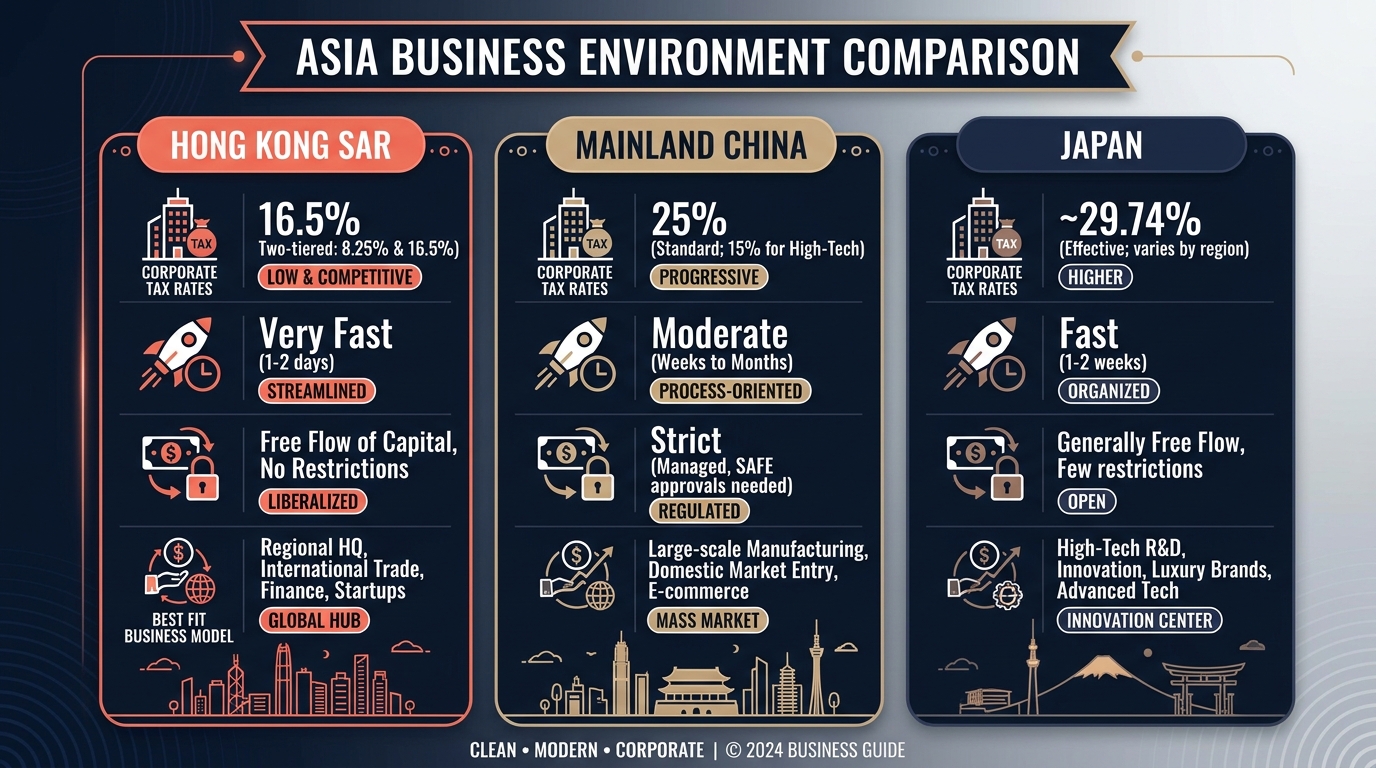
| Headline Corporate Tax Rate | 16.5% (Two-tiered: 8.25% on first HKD 2M) | 25% standard (15% for qualified High-Tech) | ~29.74% – 30.6% (combined national & local) |
| Territorial Tax System | Yes (foreign-sourced income exempt subject to FSIE rules) | No (worldwide taxation for tax residents) | No (worldwide taxation for domestic entities) |
| Capital Gains Tax | 0% (no capital gains tax) | 25% (or 10% withholding for non-residents) | Subject to standard corporate tax rates |
| Dividend Withholding Tax | 0% | 10% standard (reduced to 5% via HK treaty) | 20.42% standard (reduced to 5%–10% via treaties) |
| VAT / Consumption Tax | 0% (no GST or VAT) | 6%, 9%, or 13% VAT | 10% Japanese Consumption Tax (JCT) |
- Hong Kong: World-renowned for its simple, low-rate tax regime. Operating under a territorial tax principle, profits earned outside Hong Kong can qualify for offshore tax exemption under updated Foreign Source Income Exemption (FSIE) standards. Furthermore, Hong Kong levies no capital gains tax, no withholding tax on dividends, and no sales tax or VAT.
- Mainland China: The statutory corporate income tax rate sits at 25%. However, qualifying High and New-Technology Enterprises (HNTE) and companies incorporated in designated economic development zones (such as Hainan Free Trade Port or the Qianhai Cooperation Zone) can access a preferential 15% tax rate. In addition, leveraging the China-Hong Kong Double Tax Agreement can reduce outbound dividend withholding tax from 10% down to 5%.
- Japan: Japan maintains an effective corporate tax rate of approximately 29.74% to 30.6% (combining national corporate tax, enterprise tax, and local inhabitant tax). While higher than Hong Kong, Japan boasts an extensive network of over 80 comprehensive tax treaties that significantly reduce withholding tax on cross-border royalties, interest, and intercompany service fees under proper tax advisory and structuring.
3. Setup cost, speed and complexity
Administrative lead times and capital hurdles vary dramatically across the three jurisdictions:
- Hong Kong: The undisputed regional leader in incorporation speed. A private limited company can be incorporated in 3 to 5 business days. Paperwork is streamlined, digital submission is standard, and there are no minimum registered capital thresholds. Review our detailed Hong Kong company setup cost guide for comprehensive line-item budgets.
- Mainland China: Incorporating a WFOE requires meticulous multi-agency coordination with the State Administration for Market Regulation (SAMR), commerce departments, tax bureaus, and foreign exchange regulators. Incorporation cycles typically require 6 to 10 weeks. Furthermore, under the 2024 Company Law, all registered capital must be fully injected within a mandatory 5-year capital contribution timeline.
- Japan: Establishing a Japanese subsidiary (KK or GK) requires notarized Articles of Incorporation (Teikan), official corporate seal registration (Inkan), and local commercial bureau filings. Incorporating typically takes 2 to 4 weeks. For founders relocating to manage operations directly, the updated Business Manager Visa rules now mandate a minimum capital investment of ¥30 million and at least one full-time local staff member.
4. Banking and moving capital
The ease of opening corporate bank accounts and executing cross-border remittances is frequently the primary bottleneck for new foreign ventures in Asia.
Hong Kong
As a premier global financial center, Hong Kong maintains no foreign exchange controls. Capital moves freely in and out in major international currencies (USD, EUR, GBP, JPY, CNH). Corporate bank accounts are multi-currency by default. While local and international commercial banks enforce strict anti-money laundering and Know Your Customer (KYC) onboarding protocols, working with a licensed corporate services partner streamlines opening a corporate bank account in Hong Kong.
Mainland China
Mainland China maintains a closed capital account monitored by the State Administration of Foreign Exchange (SAFE) and the People's Bank of China (PBOC). Converting foreign currency into RMB and executing outbound profit repatriation and dividend remittances requires formal tax clearance certificates, certified annual statutory audit reports, and proof that corporate income tax has been fully settled.
Japan
Japan features a stable, sophisticated banking system with completely open capital convertibility. Funds flow freely across borders without government exchange permits. However, opening a commercial bank account (Ginko Koza) as a newly formed, foreign-owned entity requires rigorous vetting. Major megabanks (MUFG, SMBC, Mizuho) enforce strict physical office inspections and demand verified Japanese business plans, prompting many founders to open initial accounts with Japanese digital banks before onboarding with Tier-1 institutions.
5. Hiring, visas and labor law
Your human capital strategy dictates how fast your Asian operations can scale:
- Hong Kong: Boasts a flexible, business-friendly labor market modeled on common law principles. There are no mandatory severance quotas or onerous termination barriers, and statutory employee benefit contributions (Mandatory Provident Fund - MPF) are capped at just 5% of monthly income. Sponsoring international executives via the General Employment Policy (GEP) work visa is fast and reliable.
- Mainland China: The Labor Contract Law strongly protects employee tenure. Open-ended employment contracts become mandatory after two fixed terms, and statutory severance applies to virtually all employer-initiated terminations. Crucially, employer social insurance and housing fund contributions add an overhead of 30% to 40% on top of employee base salaries, making disciplined payroll outsourcing and compliance essential.
- Japan: Japanese labor culture places high value on workplace stability and consensual governance. Dismissing permanent employees (Seishain) requires demonstrating compelling commercial justification under statutory doctrine. Mandatory social insurance (Shakai Hoken—health, pension, and unemployment insurance) adds approximately 15% to 16% to employer payroll costs. Sponsoring foreign executives through Japan work visas requires structured documentation of corporate stability.
6. Strategic Decision Matrix by Business Model
To select your ideal market entry vehicle, match your primary commercial objectives to the jurisdiction that maximizes your advantages:
| Commercial Business Model | Recommended Primary Jurisdiction | Strategic Rationale |
|---|---|---|
| Global E-Commerce & Cross-Border Trading | Hong Kong SAR | Zero VAT, 0% capital gains, free FX convertibility, rapid incorporation |
| Regional Corporate Holding & Treasury Center | Hong Kong SAR | Low 16.5% tax rate, 0% dividend withholding, strong legal arbitration |
| Domestic Retail, Logistics & Supply Chain | Mainland China (WFOE) | Onshore fapiao invoicing, direct access to 1.4B consumers, domestic supplier contracts |
| Advanced Tech R&D, Robotics & High-End Luxury | Japan (KK or GK) | Wealthy domestic buyers, IP security, institutional prestige, deep industrial partnerships |
| Testing Market Traction Prior to Incorporation | Any Market via EOR | Hire local commercial talent immediately via Employer of Record (EOR) without local entity liability |
Frequently Asked Questions
Hong Kong is significantly cheaper, faster, and more capital-efficient to incorporate. Standard setup costs in Hong Kong typically range from $1,500 to $3,500 USD with no mandatory paid-in capital requirements. In contrast, establishing a Chinese WFOE involves higher administrative expenses ($3,000 to $15,000 USD) and requires committed registered capital to cover 12 to 18 months of operating runway under the 5-year contribution rule.
Conclusion & Strategic Next Steps
Choosing where to plant your corporate flag in Asia determines your operational efficiency, tax exposure, and commercial velocity for years to come. Whether you leverage the fiscal agility of Hong Kong, the vast domestic consumer scale of Mainland China, or the high-income stability of Japan, market entry success requires harmonizing your corporate legal structure with your long-term business goals.
Navigating multi-jurisdictional compliance across Asia requires experienced cross-border execution. Whether you need to model your operational expansion, incorporate a local subsidiary, or structure a regional holding hierarchy, our cross-border specialists provide end-to-end guidance across China, Hong Kong, and Japan.
Contact our regional advisory team today to evaluate your expansion roadmap or schedule a strategic cross-border consultation.


