


Running a business across borders brings exciting growth, but it also brings a web of local rules that can catch even seasoned leaders off guard. Hong Kong remains one of the world's premier commercial hubs, celebrated for its 16.5% corporate tax rate, territorial tax regime, and robust common-law legal system. However, operating here successfully requires active, ongoing statutory diligence.
Staying compliant in Hong Kong is not just about paying taxes once a year. It involves a coordinated series of legal, financial, and administrative filings executed on a strict annual calendar. Understanding what to file, when to file it, and how to avoid costly penalties is the single most effective way to protect your directors, maintain corporate bank account standing, and keep your expansion running without disruption.
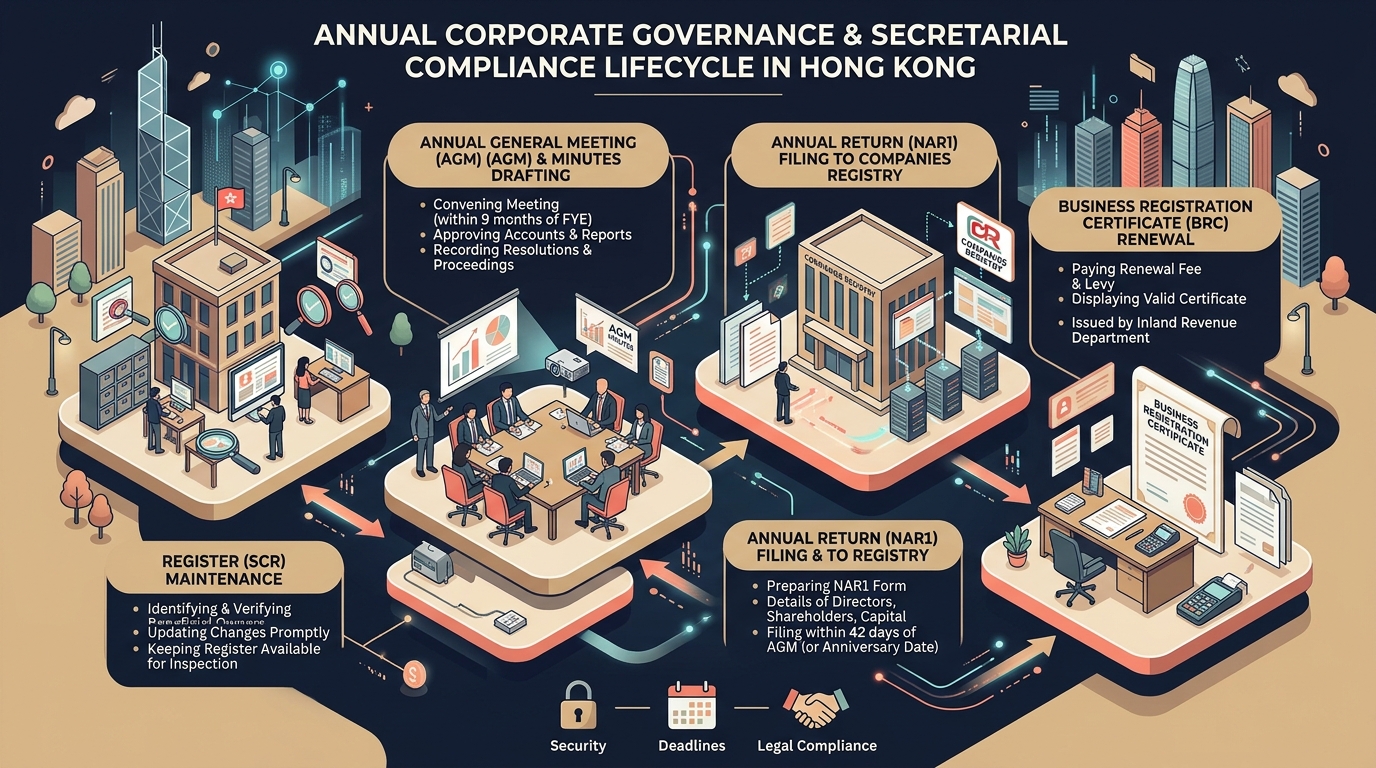
Below is the definitive breakdown of the core statutory requirements every Hong Kong company must manage to keep its doors open and its reputation spotless.
1. Annual Return (Form NAR1) to the Companies Registry
Every Hong Kong incorporated company must file an Annual Return (Form NAR1) with the Companies Registry every single year.
This document is not a tax return. Instead, it serves as an official public update detailing the statutory architecture and ownership of your enterprise. It confirms:
- Registered Office Address: Your official physical address in Hong Kong for statutory notices.
- Corporate Officers: Up-to-date identification and residential details of your directors and licensed Hong Kong company secretary.
- Shareholders and Equity Structure: Current member register, issued share capital, and voting rights.
- Significant Controllers Register (SCR): Confirmation of where your statutory register of ultimate beneficial owners is maintained.
Failing to file on time triggers a strict tiered late penalty fee. The longer you delay, the higher the government fine escalates:
| Filing Timeline | Late Filing Registration Fee | Potential Legal Action |
|---|---|---|
| Within 42 days of anniversary | HKD 105 (Standard statutory fee) | Compliant / Good standing |
| 42 days to 3 months late | HKD 870 | Late penalty applied |
| 3 months to 6 months late | HKD 1,740 | Escalated penalty |
| 6 months to 9 months late | HKD 2,610 | Serious compliance warning |
| More than 9 months late | HKD 3,480 | Company Registry court summons |
Continued failure to file an Annual Return constitutes a criminal offense under the Companies Ordinance. The Companies Registry actively prosecutes non-compliant companies and their officers, with directors facing personal fines and potential disqualification.
2. Business Registration Certificate (BRC) Renewal
Every enterprise operating a business in Hong Kong must hold a valid Business Registration Certificate (BRC) issued by the Business Registration Office of the Inland Revenue Department (IRD). Think of this as your foundational license to legally conduct commerce in the city.
When you complete your initial Hong Kong company registration, you select either a 1-year or 3-year certificate.
- The Renewal Mechanism: The Inland Revenue Department issues a renewal demand note roughly one month before your current certificate expires.
- The Golden Rule: The statutory renewal fee and the government levy must be settled on or before the exact expiry date printed on the certificate.
3. Statutory Audit and Financial Statements
A widespread misconception among international founders is that because Hong Kong operates a territorial tax system and does not tax foreign-sourced income, companies can bypass formal accounting. That is a dangerous and costly assumption.
Under Section 429 of the Hong Kong Companies Ordinance, every incorporated limited company must maintain proper books of account and have its annual financial statements audited by an independent, licensed Hong Kong Certified Public Accountant (CPA).
- The Accounting Standard: Financial statements must be prepared in accordance with the Hong Kong Financial Reporting Standards (HKFRS) or SME-FRS.
- The Audit Scope: An independent auditor reviews your general ledger, balance sheet, profit and loss statement, transaction vouchers, bank statements, and commercial contracts to verify that they provide a true and fair view of the company’s financial position.
- The Statutory Function: While the audited report is not publicly broadcast on the registry, it is a legally required document. Directors must formally present the audited statements to shareholders at an Annual General Meeting (AGM), and the Inland Revenue Department requires the audited report as a mandatory attachment to your annual tax filing.
Maintaining organized monthly bookkeeping and accounting records ensures that your year-end audit is executed swiftly without last-minute scrambling or audit qualification notes.
4. Profits Tax Return (PTR) Filing
Once a year, typically in early April, the Inland Revenue Department issues Profits Tax Returns (Form BIR51) to active commercial entities.
When your company receives this statutory return, strict statutory clocks start ticking:
- Standard Submission Window: Companies generally have one month from the date of issue to submit the completed return, along with the audited financial statements and tax computation schedule.
- Certified Tax Extensions: Companies that appoint a certified tax representative (such as our advisory team) can leverage official Block Extension schemes. Depending on your company’s fiscal year-end date, extensions can grant substantial breathing room:
- Accounting year ending between 1 December and 31 December (D Code): Extended to mid-August.
- Accounting year ending between 1 January and 31 March (M Code): Extended to mid-November.
- The First Tax Return: For newly incorporated companies, the IRD typically issues the first Profits Tax Return 18 months after incorporation, covering an extended initial accounting period of up to 18 months.
- Nil Returns Are Mandatory: Even if your enterprise generated zero revenue, operated at a net loss, or has not yet commenced active trading, you must still complete and file the return (a "Nil" return). Ignoring the form prompts the IRD to issue estimated default assessments and punitive penalty fines.
Founders planning their first fiscal year can benchmark typical administrative and filing expenses in our Hong Kong company setup cost guide.
5. Employer’s Return and MPF Obligations
If your Hong Kong enterprise employs staff—even if the only employee is an overseas founder drawing a director's fee—you hold mandatory statutory employer responsibilities:
Employer’s Return of Remuneration (Form BIR56A and IR56B)
Every April, the IRD issues employer returns requiring companies to declare all compensation paid to directors, local staff, and consultants during the preceding tax year (1 April to 31 March). This includes salaries, bonuses, allowances, housing subsidies, and share options. The return must be submitted within one month.
Mandatory Provident Fund (MPF) Enrollment
Hong Kong law mandates that employers enroll all regular and casual employees aged 18 to 65 who have been employed for 60 days or more into a registered Mandatory Provident Fund (MPF) scheme.
- Mandatory Contributions: Both the employer and employee must each contribute 5% of the employee's relevant monthly income, subject to statutory minimum and maximum earning thresholds (currently capped at HKD 1,500 per month each).
- Strict Cut-Offs: Monthly contributions must be remitted to your MPF trustee on or before the 10th day of each following calendar month. Defaulting on contributions attracts a mandatory 5% surcharge and direct enforcement action from the MPF Schemes Authority (MPFA).
6. Hong Kong Annual Compliance Master Calendar
Keeping track of multiple deadlines across different statutory bodies is essential for maintaining your corporate good standing. Below is your quick reference compliance matrix:
| Statutory Requirement | Governing Authority | Standard Filing Window | Consequence of Missing Deadline |
|---|---|---|---|
| Annual Return (Form NAR1) | Companies Registry (CR) | Within 42 days of incorporation anniversary | Escalating late filing fees up to HKD 3,480; director court prosecution |
| Business Registration (BRC) | Inland Revenue Department (IRD) | Annually or triennially on expiry date | Fixed HKD 300 penalty; legal proceedings for operating without a license |
| Annual Statutory Audit | Certified Public Accountant (CPA) | Prior to AGM & Profits Tax filing | Inability to file valid tax returns; bank account compliance freeze |
| Profits Tax Return (BIR51) | Inland Revenue Department (IRD) | Within 1 month of issue (or block extension) | Estimated tax bills, financial penalties, court summonses |
| Employer’s Return (BIR56A) | Inland Revenue Department (IRD) | Annually in April (1 month window) | Administrative fines; intense payroll audit scrutiny by tax assessors |
| Monthly MPF Remittance | MPFA / Registered Trustees | By 10th of each calendar month | Immediate 5% statutory surcharge; civil claims and director liability |
Frequently Asked Questions
What are the annual filing requirements for a Hong Kong company?
The core statutory requirements include filing your Annual Return (Form NAR1) with the Companies Registry, renewing your Business Registration Certificate, completing an annual statutory CPA audit, submitting your Profits Tax Return to the Inland Revenue Department, and lodging annual employer salary declarations alongside monthly MPF retirement contributions if you employ personnel.
When is the first profits tax return issued?
For a new Hong Kong company, the Inland Revenue Department usually issues the initial Profits Tax Return approximately 18 months after the incorporation date. However, businesses must maintain organized transaction vouchers and general ledgers from day one because the statutory audit must cover this entire extended initial operating period.
What are the penalties for late filing in Hong Kong?
Penalties depend on the specific statutory filing. For Annual Returns, late registration fees escalate from HKD 870 up to HKD 3,480 the longer you delay. For tax returns, missing deadlines results in immediate financial penalties, estimated tax assessments based on arbitrary IRD calculations, and potential criminal court summonses issued to company directors.
Can a dormant company skip the audit?
No. An enterprise cannot simply stop filing because it conducted no transactions during the year. To be legally exempt from annual statutory audits, a company must formally pass a special resolution declaring statutory dormant status and file it with the Companies Registry. Standard companies that are merely inactive or commercial outposts still require full CPA audits or compliant dormant reporting to remain in legal standing.
Protecting Your Business Future
Navigating corporate compliance in Hong Kong does not have to be a source of administrative stress. By setting up a dependable statutory calendar and partnering with experienced corporate secretarial and tax advisors, you safeguard your personal liability as a director, keep your bank accounts active, and preserve your commercial credibility across Asia.
If you want to ensure your annual filings, audits, and statutory returns are handled with precision and zero delays, contact our corporate advisory team today. We review your current standing, manage all statutory deadlines, and protect your enterprise from unexpected penalties.


